
We are Scientists
We are passionate about Science here at St Mary's and we believe that all children are born scientists with their curious minds and their enthusiasm for knowledge.
Cusp Science pays close attention to guidance provided by the National Curriculum sequence and content. It is infused with evidence-led practice and enriched with retrieval studies to ensure long-term retention of foundational knowledge. The foundations of CUSP science are cemented in the EYFS through learning within the Natural World, and People, Culture and Communities.
Our ambitious interpretation of the National Curriculum places knowledge, vocabulary, working and thinking scientifically at the heart of our principles, structure and practice.
- Substantive knowledge– this is the subject knowledge and explicit vocabulary used to learn about the content. Common misconceptions are explicitly revealed as non-examples and positioned against known and accurate content. In science, an extensive and connected knowledge base is constructed so that pupils can use these foundations and integrate it with what they already know. Misconceptions are challenged carefully and in the context of the substantive and disciplinary knowledge.
- Disciplinary knowledge– this is knowing how to collect, use, interpret, understand and evaluate the evidence from scientific processes. This is taught. It is not assumed that pupils will acquire these skills by luck or hope. Pupils construct understanding by applying substantive knowledge to questioning and planning, observing, performing a range of tests, accurately measuring, comparing through identifying and classifying, using observations and gathering data to help answer questions, explaining and reporting, predicting, concluding, improving, and seeking patterns. We call it ‘Working Scientifically.’
Scientific analysis is developed through IPROF criteria. We call it ‘Thinking Scientifically.’
- identifying and classifying
- pattern seeking
- research
- observing over time
- fair and comparative testing
- Substantive concepts include concrete examples, such as ‘plant’ or more abstract ideas, such as ‘biodiversity’. Concepts are taught through explicit vocabulary instruction as well as through the direct content and context of the study.
A guiding principle of Science is that each study draws upon prior learning. For example, in the EYFS, pupils may learn about The Natural World through daily activities and exploring their locality and immediate environment. This is revisited and positioned so that new and potentially abstract content in Year 1, such as Animals, including humans, is related to what children already know. This makes it easier to cognitively process. This helps to accelerate new learning as children integrate prior understanding.
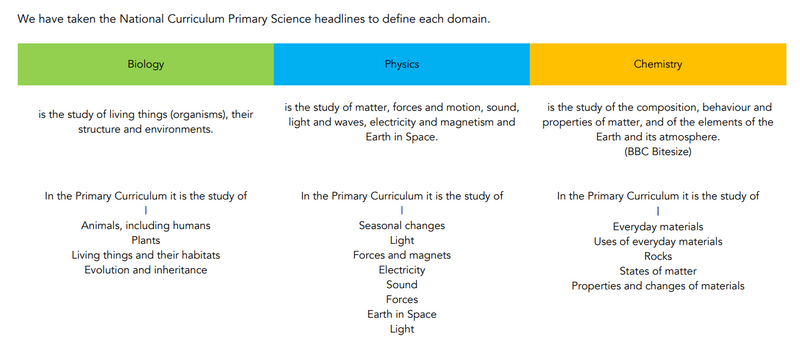
Our science curriculum is organised into three distinct subject domains: biology, physics and chemistry. Where inter-disciplinary concepts are encountered, such as the particle model, these are taught explicitly and connected across science domains.
Through studying CUSP science, pupils become ‘a little more expert’ as they progress through the curriculum, accumulating, connecting and making sense of the rich substantive and disciplinary knowledge.
At St Mary's we love hands-on Science; every year we take part in many whole-school practical Science events, including Space Week, British Science Week and Ulverston Eco Fair. We also take part in recycling week, STEM opportunities and run our very own Eco Committee, the Co-creators.
We believe that introducing children the science in a practical, fun and explority way can ignite a love for the subject and a curiosty for the world around them. We often take science outside, such as in our 'whole-school' experiments and arrange science trips. Last Year, KS2 visited the Museum of Science and Industry in Manchester and gained so much from the experience.
We are always looking for parents who work in any industries relating to the sciences to get in touch about coming in to speak to the children. Please contact admin@st-marys.cumbria.sch.uk.
Curriculum Topic Overview
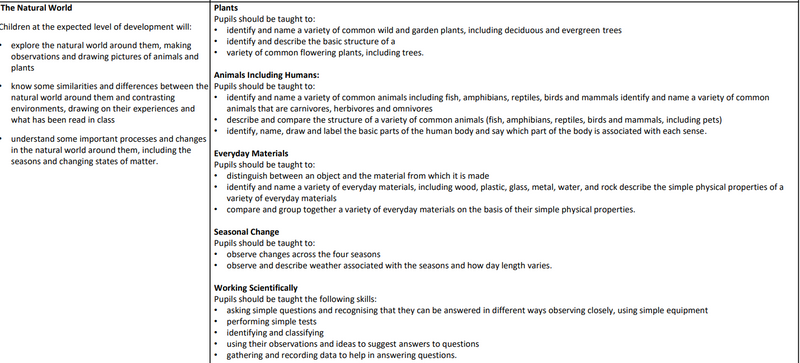
Below are the National Curriculum links and science overview:
ELGs and KS1 Science
Some of the Scientific Vocabulary we use
Year 3 Science Vocabulary

We are an Eco School and we were awarded the prestigious Green Flag last year for our work. Our Eco-Committee meets every Friday lunchtime and has already made great impact on our school, including introducing compost bins in classrooms.

Science in EYFS
At St Mary’s, Science in EYFS is introduced to children mainly through the specific areas of the EYFS Framework: Understanding of the World. It is also embedded into other areas of the Early Years curriculum as well as being taught as a discrete subject weekly. Children experience scientific understanding through many engaging and exploratory hands-on experiences in the classroom and in our extensive school grounds. These early experiences help children develop essential skills such as observation, questioning, and problem-solving, forming the basis for more structured scientific investigations in primary school. We use CUSP and Developing Experts to support the delivery of our science curriculum in EYFS.
These are the Science outcomes from Understanding of the World area of the EYFS Framework:
Birth to three year olds:
-
Repeat actions that have an effect.
-
Explore materials with different properties.
-
Explore natural materials, indoors and outside.
3-4 year olds:
-
Use all their senses in hands-on experiences of natural materials.
-
Explore collections of materials with similar and or different properties.
-
Talk about what they see, using a wide vocab.
-
Explore how things work.
-
Plant sees and cares for growing plants.
-
Understand the key features of the life cycle of a plant and an animal.
-
Begin to understand the need to respect and care for the natural environment and all living things.
-
Explore and talk about differences between materials and changes they notice.
ELG:
-
Explore the natural world around them.
-
Describe what they see, hear and feel whilst outside.
-
Understand the effect of changing seasons on the natural world around them.
-
Explore the natural world around them, making observations and drawing pictures of animals and plants.
-
Know some similarities and differences between the natural world around them and contrasting environments, drawing on their experiences and what has been read in class.
-
Understand some important processes and changes in the natural world around them, including the seasons and changing states of matter.