
We are Geographers
Aims of the Geography Curriculum
The national curriculum for Geography aims to ensure that all pupils:
- develop contextual knowledge of the location of globally significant places – both terrestrial and marine – including their defining physical and human characteristics and how these provide a geographical context for understanding the actions of processes
- understand the processes that give rise to key physical and human geographical features of the world, how these are interdependent and how they bring about spatial variation and change over time
- are competent in the geographical skills needed to:
- collect, analyse and communicate with a range of data gathered through experiences of fieldwork that deepen their understanding of geographical processes
- interpret a range of sources of geographical information, including maps, diagrams, globes, aerial photographs and Geographical Information Systems (GIS)
- communicate geographical information in a variety of ways, including through maps, numerical and quantitative skills and writing at length.
At St Mary’s it is our intention that pupils become a little more expert as they progress through the curriculum, accumulating and connecting substantive and disciplinary geographical knowledge.
- Substantive knowledge– this is the subject knowledge and explicit vocabulary used to learn about the content. Common misconceptions are explicitly revealed as non-examples and positioned against known and accurate content as pupils become more expert in their understanding. Misconceptions are challenged carefully and in the context of the substantive and disciplinary knowledge. In Geography, it is recommended that misconceptions are not introduced too early, as pupils need to construct a mental model in which to position new knowledge.
- Disciplinary knowledge– this is the use of that knowledge and how children construct understanding through processes, evidence, pattern seeking, reasoning and explaining change. We call it ‘Thinking Geographically’.
- Geographical analysis is developed through selecting, organising and integrating knowledge through reasoning and inference making in response to structured questions and challenges.
- Substantive concepts include place, space, scale, interdependence, physical and human processes, environmental impact, sustainable development, cultural awareness and cultural diversity. Concepts such as change through erosion are taught through explicit vocabulary instruction as well as through the direct content and context of the study.
A guiding principle of our Geography scheme of learning is that each study draws upon prior learning. For example, in the EYFS, pupils may learn about People, Culture and Communities or The Natural World through daily activities and exploring their locality and immediate environment. This is revisited and positioned so that new and potentially abstract content in Year 1 can be put into a known location and make it easier to cognitively process. Pupils in EYFS explore globes and world locations through their curiosity corners, making links to where animals live. This substantive knowledge is used to remember and position the locations of continents and oceans, with more sophisticated knowledge. High volume and deliberate practice is essential for pupils to remember and retrieve substantive knowledge and use their disciplinary knowledge to explain and articulate what they know. This means pupils make conscious connections and think hard, using what they know.
Geography is built around the principles of cumulative knowledge focusing on spaces, places, scale, human and physical processes with an emphasis on how content is connected and relational knowledge acquired. An example of this is the identification of continents, such as Europe, and its relationship to the location of the UK.
The Geography curriculum equips pupils to become ‘more expert’ with each study and grow an ever broadening and coherent mental model of the subject. This guards against superficial, disconnected and fragmented geographical knowledge. Specific and associated geographical vocabulary is planned sequentially and cumulatively from Y1 to Y6. High frequency, multiple meaning words (Tier 2) are taught and help make sense of subject specific words (Tier 3). Each learning module in geography has a vocabulary module with teacher guidance, tasks and resources.
The Geography curriculum is planned so that the retention of knowledge is much more than just ‘in the moment knowledge’. The cumulative nature of the curriculum is made memorable by the implementation of Bjork’s desirable difficulties, including retrieval and spaced retrieval practice, word building and deliberate practice tasks. This powerful interrelationship between structure and research-led practice is designed to increase substantive knowledge and accelerate learning within and between study modules. That means the foundational knowledge of the curriculum is positioned to ease the load on the working memory: new content is connected to prior learning. The effect of this cumulative model supports opportunities for children to associate and connect with places, spaces, scale, people, culture and processes.
2024 - 2025
2025 -2026
2026 -2027
Guided Walks
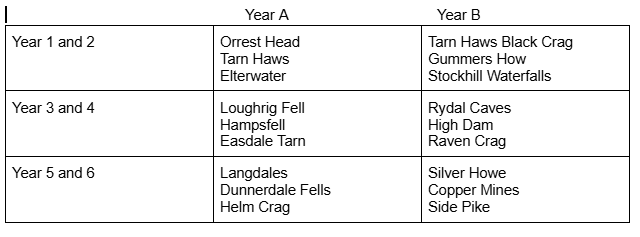
We love being in the outdoors at St Mary's . On our guided walks we have the opportunity to use our field work and map skills. Here is an example of our guided walk timetable:

Geography in EYFS
Geography in the Early Years involves guiding pupils to make sense of their world, through opportunities to explore, observe, and find out about people, places, technology, and the environment; noticing, and having time to recreate, simple patterns and processes in the world around them as they do so.
These are the Geography outcomes from Understanding of the World area of the EYFS Framework:
Birth to three year olds:
-
Explore and respond to different natural phenomena in their setting and on trips.
3-4 year olds:
-
Use all their senses in hands-on experiences of natural materials.
-
Talk about what they see, using a wide vocabulary.
-
Begin to understand the need to respect and care for the natural environment and all living things.
-
Know that there are different countries in the world and talk about the differences they have experienced or seen in photos.
ELG:
-
Draw information from a simple map.
-
Recognise some environments that are different from the one in which they live.
-
Describe what they see, hear and feel whilst outside.
-
Explore the natural world around them.
-
Understand the effect of changing seasons on the natural world around them.
-
Understand some important processes and changes in the natural world around them, including the seasons and changing states of matter.